Piano trio
Plus lucis · Op. 35
Violin, cello and piano. Four movements exploring energy, sound and musical development.


Composer
Born in Linz in 1962, Alfred Huber brings together music, medicine and social questions in his creative work. He studied composition with Gunter Waldek and Herbert Willi and trained as a neurosurgeon. His output spans chamber music, orchestral works and music theatre.
Read the full biographyBorn in Linz in 1962, Alfred Huber brings together music, medicine and social questions in his creative work. He studied composition with Gunter Waldek and Herbert Willi and trained as a neurosurgeon. His output spans chamber music, orchestral works and music theatre.
He has lived in the Allgäu region of Germany since 1996 and received the Richard Wagner Prize in Vorarlberg in 1999. His compositions range from works for solo instruments to symphonic music.
His music has been performed at the Kuhmo Chamber Music Festival, Enoarmonie in Cividale, Slowind in Ljubljana, Suoni riflessi in Florence, the Europäische Wochen Passau and the Vienna Musikverein.
Collaborators include Andrea Rucli, Dan Zhu, Vladimir Mendelssohn, Othmar Müller, Katharina Gross, Niek de Groot, Catherine Dubosc, the Artis Quartet Vienna, the Enesco Quartet Paris, Slowind, Ensemble Nuovo Contrappunto, Capella Istropolitana and the Wiener Concert-Verein, with conductors including James Judd, Alicja Mounk, Philippe Entremont, Lorenzo Viotti and Christoph Campestrini. His works have been broadcast by ORF, RAI, Bayern 4 Klassik, WDR and SWR 2.
A founding member of the Internationaler Konzertverein Bodensee, Huber also founded Zeitklänge e.V. in Kempten and served as its first chairman. Since 2002 he has organised a chamber music series in Wengen, Allgäu. The Zeitklänge festival “Emotion and Meaning in Music” received support from the Bavarian Cultural Fund in 2009.
He was composer in residence at the Europäische Wochen Passau in 2012, at the Wörthersee Classics in 2014 and with the Wiener Concert-Verein in 2014–2015. The album “Duos for Violin & Double Bass” was nominated for the 2019 International Classical Music Awards (ICMA).
He has served on the jury of the Stefanie Hohl Competition at mdw Vienna (2024) and the Heinrich Schiff Competition at mdw.
Piano trio
Violin, cello and piano. Four movements exploring energy, sound and musical development.
Sonata
Cello, piano and percussion. Three movements in which music and poetry meet.
Duo
Violin and double bass. Two string instruments, two perspectives and a shared musical space.
Concerto
Violin and chamber orchestra. Excerpts from the second and third movements.
PI, Op. 32 – Sonata for violin and piano · Listen at Audite ↗
From the dialogue of two instruments to large-scale orchestral music.
Catalogue by instrumentation
Symphony No. 1 · Op. 39
A three-movement symphony for large orchestra meets an animated film. Conceived as a projection behind the orchestra, the images offer another way into the work.
Explore the work → · Trailer and film project ↗
Artes liberales, Op. 43 – a septet for strings, clarinet, horn and bassoon.
Recordings of chamber and orchestral music.
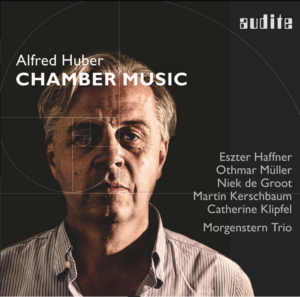
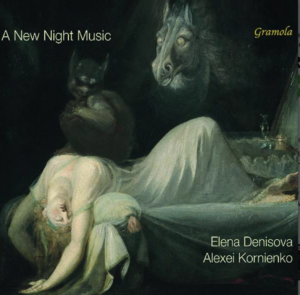
Gramola · 2022
Featuring Incubus, Op. 36, with Elena Denisova and Alexej Kornienko.
CD and details ↗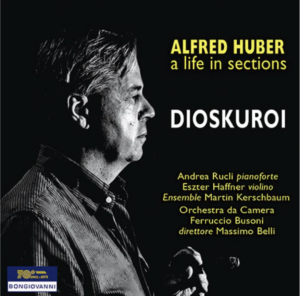
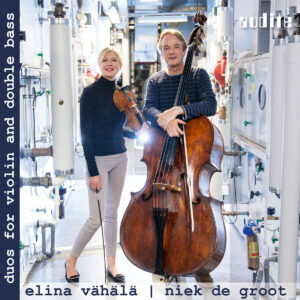
Audite · 2018
Featuring (Re)actio, Op. 18, with Elina Vähälä and Niek de Groot.
CD and details ↗Past performance
Plus lucis, Op. 35 – piano trio. Performed by the Lyatoschinsky Trio.
4 May 2025
World premiere of A.E.I.O.U., Op. 40, a rondo for chamber orchestra, percussion and organ. Festival Sinfonietta conducted by Christoph Campestrini.
26 November 2022
“Ich grolle nicht”, Op. 38, and “Ver sacrum”, String Quartet No. 3, Op. 30. Eszter Haffner, Benedikt Huber, Kristof Hrastnik and the Artis Quartet Vienna.
1 May 2022
(Re)actio, Op. 18. Laura Hildebradt and Agnieszka Detko, in a concert of the Josef Joachim Academy.
23 July 2021
Cognition II, Op. 19, performed by the Wiener Concert-Verein.

Partituren und Stimmen
Vom ersten Blick in die Partitur bis zur eigenen Interpretation: Entdecken Sie die zuletzt erschienenen Notenausgaben meiner Werke. Vorschau und Kauf sind direkt bei MusicaNeo möglich.
Oktober 2026
Alfred Hubers Streichquartett Nr.2, Op.14 ist ein Werk der zeitgenössischen klassischen Musik und setzt sich mit ebendieser quasi in einer Metaebene auseinander. Es ist somit ein Quartett über ein Quartett. Ironisch werden die verschiedenen Techniken der zeitgenössischen Musik gebrochen. Ganz am Beginn des 2. Satzes lädt es nahezu zum Mitsingen ein. Die Besetzung ist die eines klassischen Streichquartetts, Dauer ca. 18 min.
Für Streicher, die ein als schwer eingestuftes Quartett in ihr Repertoire aufnehmen möchten, bietet diese Ausgabe Partitur und Stimmen zur gemeinsamen Arbeit. Sie lädt erfahrene Ensembles dazu ein, sich mit Hubers zweitem Streichquartett in seiner vollständigen, dreisätzigen Form zu beschäftigen.
Oktober 2026
Wie lässt sich Farbe in Musik verwandeln? Alfred Hubers Chromophor erkundet diese Frage in drei Sätzen: Moderato – Rot, Adagio – Blau und Allegro – Orange-Weiß. Chromatische Linien, spannungsreiche Zusammenklänge und wechselnde Klangfarben verbinden sich zu einem ausdrucksstarken Dialog zwischen Viola und Klavier. Die eingetragenen poetischen Textfragmente eröffnen eine zusätzliche Deutungsebene.
Für eingespielte Duos bietet Chromophor eine reizvolle Verbindung aus klanglicher Entdeckungsfreude, instrumentalem Anspruch und poetischer Anregung. Eine lohnende Repertoirewahl für Musikerinnen und Musiker, die zeitgenössische Kammermusik mit einer lebendigen Ausdruckswelt suchen.
September 2026
„Purgatorio“, „Inferno“ und „Paradiso“ bilden die drei Stationen dieser Symphonie. Als Verbindung von Orchestermusik und einem entstehenden Animationsfilm eröffnet „Resistenza“ einen Zugang zu historischen und gesellschaftlichen Fragen. Die Partitur lädt dazu ein, diese musikalische Dramaturgie zu entdecken und für den Konzertsaal zu erschließen. Partitur und Orchesterstimmen sind als getrennte Ausgaben erhältlich.
Januar 2026
Von der Zahl zum Klang: Die Ziffern der Kreiszahl π geben den Anstoß zu Intervallfolgen und musikalischen Phrasen. In „Allegro“, „Adagio“ und „Presto“ gewinnt die Musik zunehmend Freiheit gegenüber ihrem Ausgangsprinzip. Für erfahrene Duos eröffnet sich ein reizvolles Spannungsfeld zwischen Konstruktion und Ausdruck – eine Entdeckung für Programme mit zeitgenössischer Kammermusik.
Januar 2026
„Mehr Licht“: Der Titel weist den Weg durch Spannung und Widerstand zu einem geklärten Schluss. Im Beethoven-Jahr 2020 entstanden, verbindet das Trio seine vier Sätze durch wiederkehrende Motive zu einem großen musikalischen Zusammenhang. Eine lohnende Aufgabe für eingespielte Ensembles, die in zeitgenössischer Kammermusik Ausdruckskraft und einen zusammenhängenden musikalischen Bogen suchen.
Scores and parts
From a first look at the score to your own interpretation: discover the latest sheet music editions of my works. Previews and purchases are available directly through MusicaNeo.
October 2026
Alfred Huber’s Streichquartett Nr.2, Op.14 is a contemporary classical work for quartet, with violin, viola and cello listed as its instruments. The work comprises three movements and has a stated duration of 18 minutes. This edition provides both the score and the instrumental parts, covering all three movements of the quartet.
For experienced string ensembles seeking a quartet rated difficult, the score and parts offer the materials for working on the complete work together. Performers interested in Huber’s second string quartet are invited to explore it in its full three-movement form.
October 2026
How can colour be transformed into music? Alfred Huber’s Chromophor explores this question in three movements: Moderato – Red, Adagio – Blue and Allegro – Orange–White. Chromatic lines, tension-filled harmonies and shifting tone colours combine in an expressive dialogue between viola and piano. The poetic text fragments inscribed in the score open up an additional layer of interpretation.
For established duos, Chromophor offers an engaging blend of sonic discovery, instrumental challenge and poetic inspiration. A rewarding repertoire choice for musicians seeking contemporary chamber music with a vivid expressive world.
September 2026
“Purgatorio”, “Inferno” and “Paradiso” mark the three stages of this symphony. Conceived as a meeting of orchestral music and an animated film currently in development, “Resistenza” opens a way into historical and social questions. The score invites performers to explore this musical drama and bring it to the concert hall. The full score and orchestral parts are available as separate editions.
January 2026
From number to sound: the digits of π inspire sequences of intervals and the shaping of musical phrases. Across “Allegro”, “Adagio” and “Presto”, the music gradually gains freedom from its initial principle. For experienced duos, the sonata offers a compelling interplay between structure and expression – a rewarding discovery for programmes of contemporary chamber music.
January 2026
“More light”: the title points towards a path through tension and resistance to a conclusion of renewed clarity. Written in the Beethoven anniversary year of 2020, the trio connects its four movements through recurring motifs into a larger musical whole. A rewarding choice for established ensembles seeking expressive depth and a sustained musical arc in contemporary chamber music.
Partiture e parti
Dal primo sguardo alla partitura alla propria interpretazione: scoprite le più recenti edizioni delle mie opere. Le anteprime e l’acquisto sono disponibili direttamente su MusicaNeo.
Ottobre 2026
Streichquartett Nr.2, Op.14 di Alfred Huber è un’opera di musica classica contemporanea per quartetto. Gli strumenti indicati sono violino, viola e violoncello. Il lavoro comprende tre movimenti e ha una durata dichiarata di 18 minuti. L’edizione mette a disposizione sia la partitura sia le parti strumentali e include tutti e tre i movimenti dell’opera.
Per gli ensemble d’archi esperti che desiderano affrontare un quartetto classificato come difficile, questa edizione offre i materiali per il lavoro d’insieme. Partitura e parti invitano gli interpreti a conoscere il secondo quartetto di Huber nella sua forma completa in tre movimenti.
Ottobre 2026
Come si può trasformare il colore in musica? Chromophor di Alfred Huber esplora questa domanda in tre movimenti: Moderato – Rosso, Adagio – Blu e Allegro – Arancione-Bianco. Linee cromatiche, armonie ricche di tensione e timbri mutevoli si intrecciano in un dialogo espressivo tra viola e pianoforte. I frammenti poetici riportati in partitura aprono un ulteriore livello di interpretazione.
Per i duo affiatati, Chromophor offre un suggestivo connubio di scoperta sonora, impegno strumentale e ispirazione poetica. Una preziosa scelta di repertorio per musicisti e musiciste alla ricerca di musica da camera contemporanea dal vivace mondo espressivo.
Settembre 2026
«Purgatorio», «Inferno» e «Paradiso» scandiscono le tre tappe di questa sinfonia. Concepita come incontro tra musica orchestrale e un film d’animazione in fase di realizzazione, «Resistenza» apre una prospettiva su questioni storiche e sociali. La partitura invita a esplorare questa drammaturgia musicale e a darle vita in sala da concerto. La partitura e le parti d’orchestra sono disponibili in edizioni separate.
Gennaio 2026
Dal numero al suono: le cifre di π ispirano successioni di intervalli e l’articolazione delle frasi musicali. Attraverso «Allegro», «Adagio» e «Presto», la musica acquista una crescente libertà rispetto al principio iniziale. Per i duo esperti, la sonata offre un affascinante dialogo tra costruzione ed espressione: una scoperta preziosa per i programmi di musica da camera contemporanea.
Gennaio 2026
«Più luce»: il titolo indica un percorso che attraversa tensione e resistenza per giungere a una conclusione di ritrovata chiarezza. Nato nel 2020, anno delle celebrazioni beethoveniane, il trio unisce i suoi quattro movimenti attraverso motivi ricorrenti in un ampio disegno musicale. Una proposta stimolante per ensemble affiatati che cercano forza espressiva e continuità del discorso nella musica da camera contemporanea.